

Self-Portrait #1
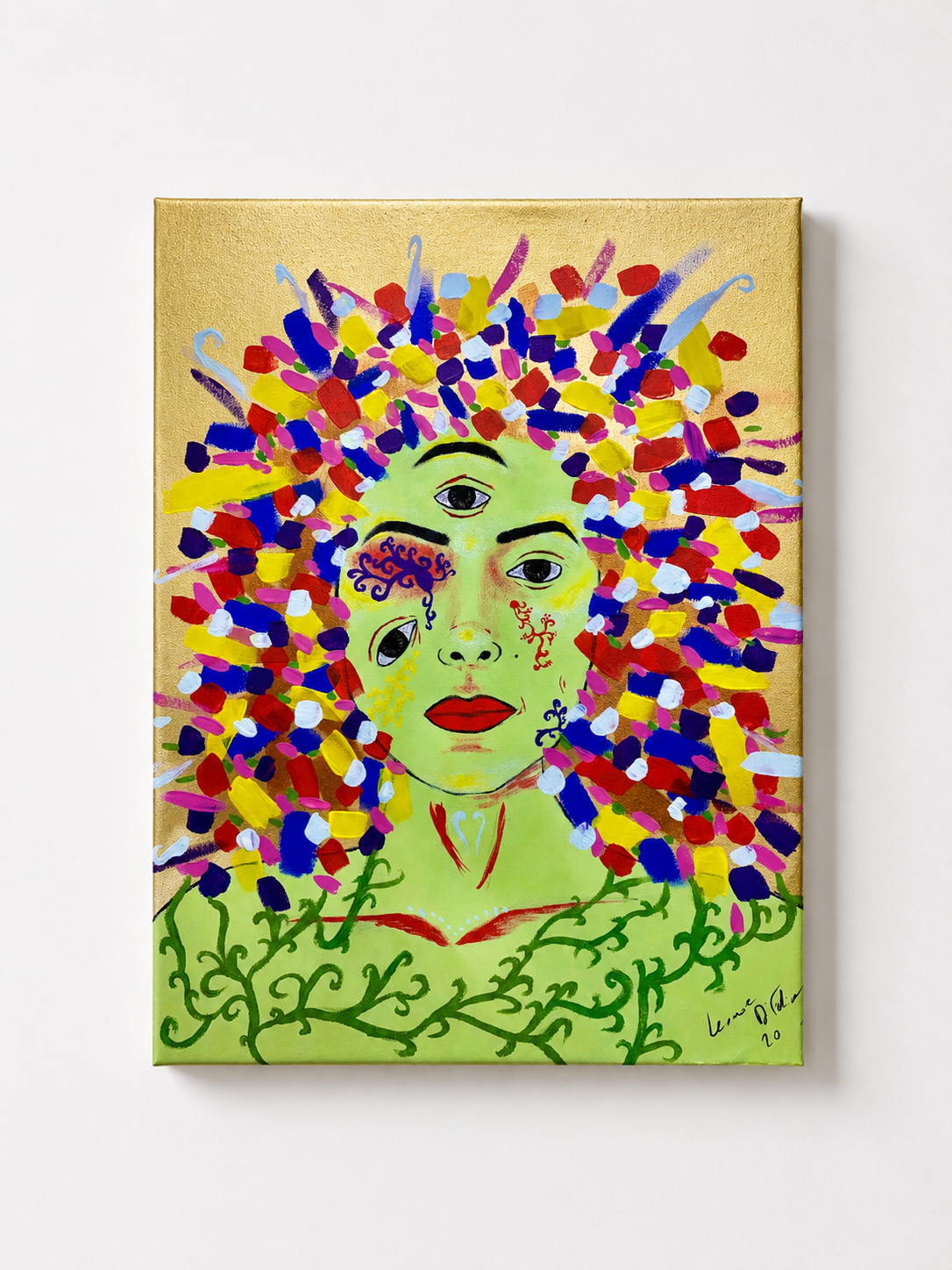
Self-Portrait #1
2020
Acrylic on canva
60×80cm
This self-portrait transforms the artist’s face into an open, fluid, and symbolic mental space. Rather than representing a stable identity, the painting stages an inner multiplicity: thoughts, perceptions, impulses, and emotional states seem to emerge simultaneously across the surface of the face, dissolving any traditional idea of portraiture as mere physical resemblance.
The figure appears frontally, almost like a contemporary icon, immersed in a golden background that recalls both sacred painting and a decorative, theatrical dimension. Yet the work avoids any rigid solemnity. Its visual language remains free, instinctive, and deeply imaginative, sustained by a radical use of color and a deliberately anti-naturalistic construction.
The multiple eyes distributed across the face become the symbolic center of the composition. They do not suggest deformation or unease, but rather an expansion of vision and consciousness. It is as if the portrait rejects the idea of a single stable point of view, presenting instead a layered and shifting perception capable of observing both the external world and the inner self at the same time.
The chromatic mass surrounding the head explodes into saturated tones — red, electric blue, yellow, pink, and violet — becoming almost a visual manifestation of the subject’s emotional and mental activity. Color does not describe reality here; it invades, creates rhythm, and generates energy. The rapid, spontaneous brushstrokes keep the painterly gesture visible, allowing the work to preserve a vivid and immediate quality.
The ornamental and vegetal elements emerging in the lower part of the canvas further reinforce the sense of growth and continuous proliferation. The figure seems to arise from an imaginary ecosystem where identity, nature, and perception coexist without clear boundaries. Everything within the work suggests transformation, inner movement, and expressive freedom.
What makes the painting particularly compelling is its balance between symbolic complexity and visual lightness. The work approaches the theme of identity without turning it into a closed or dramatic narrative. Instead, it leaves room for ambiguity, irony, and the possibility of coexisting with multiple versions of the self.
Within an exhibition context, the piece stands out as a contemporary self-portrait that uses symbolic and pop-surrealist language not to define identity, but to expand it continuously. It is a work that does not seek definitive answers, but rather celebrates the emotional and imaginative complexity of human experience through instinctive, vibrant, and deeply personal painting.e