

Passo a Quattro
Passo a quattro
2024
Acrylic on canva
20×20cm
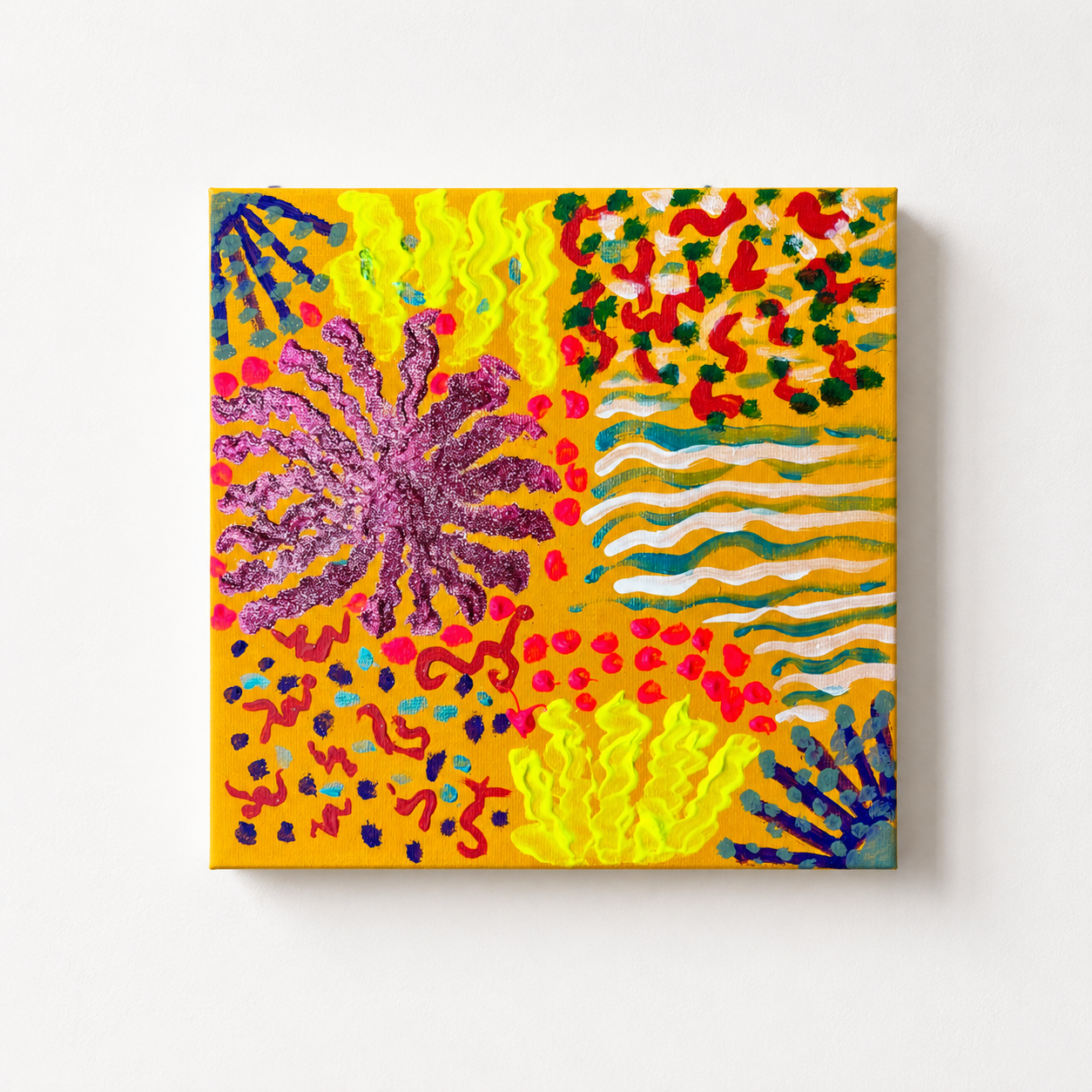
“Passo a Quattro” belongs to a series of four canvases created through a collective and intergenerational process involving the artist, her parents, and her grandmother. The title evokes a dance: four bodies, four hands, four different rhythms moving across the same surface. Each family member began with one canvas before passing it to the next, until every person had contributed to each of the four works. This particular canvas originated from the artist herself, who established the initial composition and visual rhythm before the surface was progressively transformed by the others.
More than a collaborative painting, the work becomes a way of experiencing family through art — and art through the emotional lens of family memory. Every mark on the canvas carries not only aesthetic intention, but the physical presence of a specific person, a specific gesture, and a specific moment shared between generations. The surface becomes a meeting point between different sensibilities, ages, and relationships to creativity itself.
The emotional depth of the piece is inseparable from the history behind it. Both the artist’s father and grandmother painted in the past. Her father eventually stopped, while her grandmother, now bedridden, can no longer paint. Within this context, the canvas acquires the quality of a living archive: not simply an artwork, but the preservation of gestures that may no longer be repeated. The painting holds traces of movement, participation, and creative dialogue that time itself has interrupted.
Yet what makes the work particularly powerful is that it never collapses into nostalgia. Despite the emotional history embedded within it, the painting remains vibrant, playful, and intensely alive. Its energy comes not from mourning what has been lost, but from celebrating the fact that these gestures existed together in the first place. The canvas does not feel like a memorial object; it feels active, expanding, and full of movement.
Rather than separating individual contributions, the composition intentionally blurs authorship. Shapes overlap without hierarchy, colors interrupt and respond to one another, and visual motifs emerge organically through interaction rather than control. Spirals, waves, branching forms, dotted structures, and explosive radial patterns coexist across the intense yellow background like fragments of multiple visual languages sharing the same emotional space.
The work embraces difference instead of forcing harmony through uniformity. Its balance emerges precisely through coexistence — through contrasting rhythms, interruptions, spontaneity, and layered responses between family members. Each intervention becomes both an act of self-expression and an act of response to another person’s gesture. In this sense, the painting transforms into a visual conversation unfolding across generations.
The canvas functions simultaneously as abstraction, memory, and emotional exchange. It transforms painting into a form of familial contact that survives beyond words: a record of affection, continuity, interruption, inheritance, and presence. Even in the silence or absence of those who can no longer paint, their gestures remain active on the surface, continuing to interact with the living.
Within an exhibition context, the work stands out not only for its chromatic vitality and instinctive abstraction, but for the emotional complexity embedded within its process. By replacing the idea of the solitary artist with a circulating and collective act of creation, the piece redefines painting as a space of transmission between generations. The result is an artwork that feels deeply personal yet unexpectedly universal — not because it idealizes family, but because it captures the fragile and joyful experience of building something together.